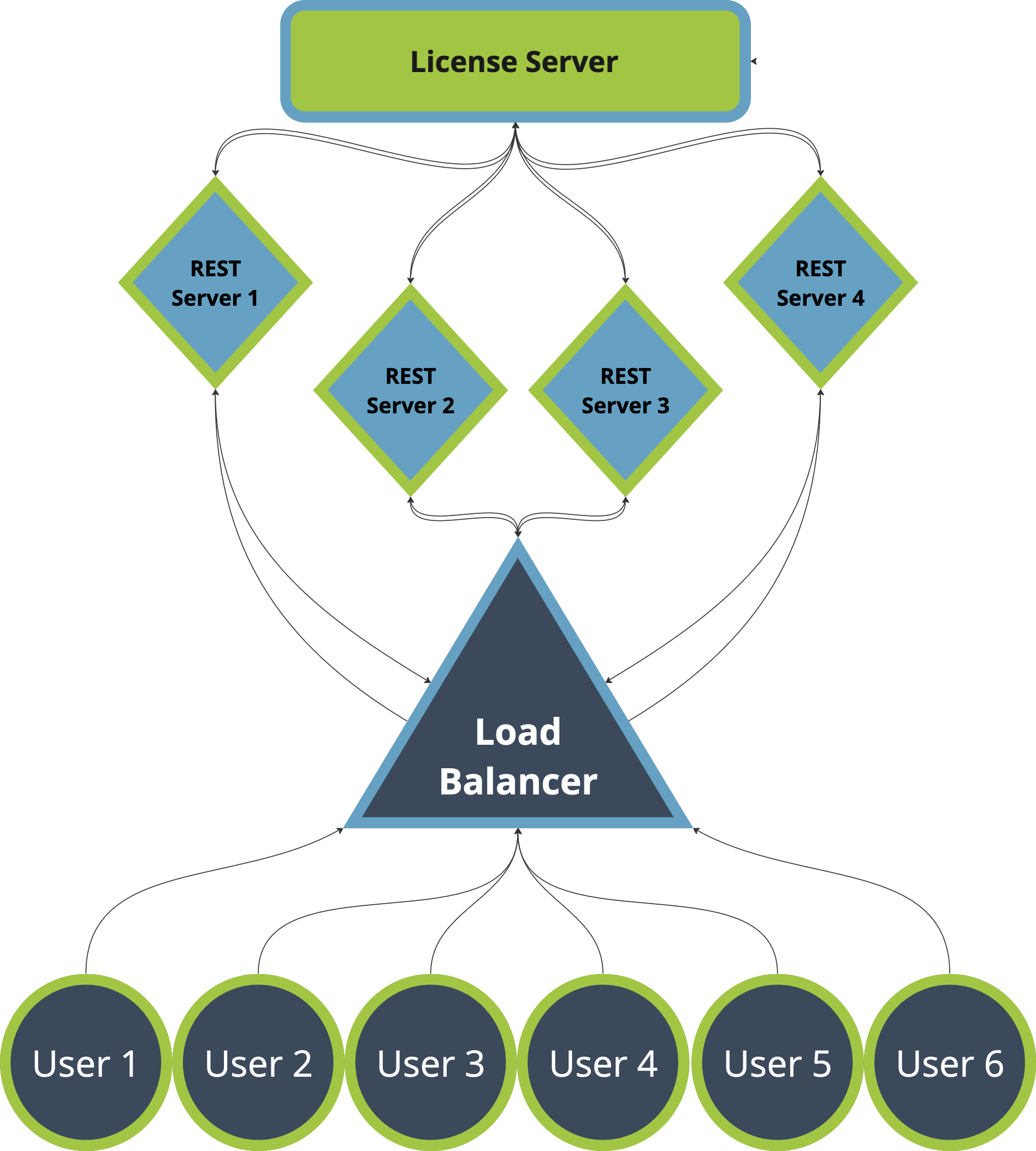
When creating a license server to REST server connection there are 2 main ways suggested to do this.
The Simplest Way
To quickly have both a license server and REST server running, connected and operating, its possible to start both on the same machine. This requires 2 command line terminals to be opened and in the first the following command to be entered:
*PATH_TO_FLEXLM_DIR*/lmgrd -c *PATH_TO_LICENSE_FILE*
This will start a license server with the given information from the license file provided.
Then in the second terminal the command:
java -jar *PATH_TO_REST_JAR* license-servers=*HOSTNAME*
This will start a REST server and connect it to the already running license server. More information about what Hostname to use can be found here.
You now have the ability to send operational requests to the REST server through your API tool of choice. Our guide to using Postman with your REST servers can be seen here.
The Recommended Way
To make a robust and versatile server architecture, we advise the use of a micro or nano EC2 instance on which to run the license server (For startup commands for license servers read here). However for we suggest using a large EC2 instance per set of 2 REST servers (For startup commands for REST servers read here).
This implementation works and behaves the same as the simplest way, but with much more flexibility to meet your operational requirements. With the ease of REST server startup/shutdown and along side the use of Partial Fulfillment, its possible to have mass scalability proportional to the total number of concurrent operations included in your deal.
The Complete Way
To fully round out your architecture a load balancer can be included between the API requesting tool (Postman) and the REST servers. The load balancer will adjust which REST server it sends operations to based on whats already running where. With this addition a single REST server will never end up computing all concurrent operations on its own, whilst the other servers sit idle. The design, creation and implementation of a load balancer is the responsibility of each customer and their individual use case.
What Is A Load Balancer
Instead of requests going directly to individual REST servers, a load balancer is used instead so all operation requests go through it. When a request is sent, the load balancer allocates the request to a REST server to avoid congestion and spread the computations to available servers. It decides which server to send the request to based on the algorithm of choice of its designer.